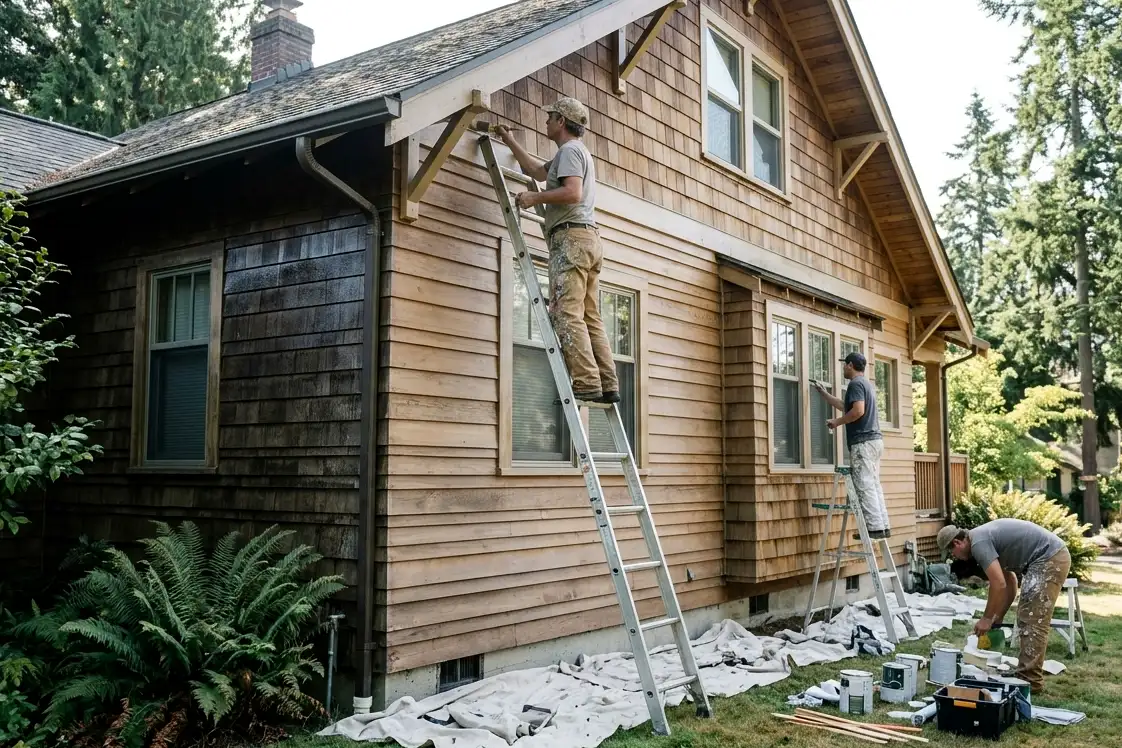
Around Tacoma and Puget Sound, the most reliable time for exterior painting is late May to mid September. Siding is dry enough, nights stay mild, and rain gaps last long enough for paint to cure. Work can stretch into early fall on good weeks, but shorter days and heavier dew cut the working hours. Book your walk-through in early spring for the best choice of dates.
Why the dry season matters so much here
Paint does two jobs as it dries. It has to bond to the surface, and it has to form a film that sheds water. Both go wrong when the wood is wet. Here in western Washington the wet season runs roughly October to May, and cedar and plywood siding soak up a lot of water through those months. Even after a few dry days, the siding behind gutters and on shaded walls can still hold moisture. Paint applied over damp wood tends to blister or peel, sometimes within the very first winter.
That is why we measure instead of guessing. Before we prime or paint, we check the siding with a moisture meter, and wood should read about 15% or less. In late May that number can still be high on north faces, while south walls are ready to go. By July most homes test dry everywhere. Planning around those readings lets us paint each side when it is ready instead of forcing the whole house onto one date. If you want a rough sense before calling, try our siding moisture check at home.
Late May to mid September: the core window
For most homes in Tacoma, Puyallup and the surrounding towns, the strongest stretch for exterior painting starts in late May and runs to mid September. Daytime temperatures usually sit comfortably above the minimums on paint labels, nights stay mild enough for paint to keep curing, and multi-day dry spells are common. July and August are the most predictable months. June can bring a few showery weeks, so we keep a close eye on forecasts and shift between sides of the house around rain gaps when needed.
Because that window is short, demand piles into it. Homeowners who call in late June often find most of the summer already booked. The practical answer is to plan early. A walk-through in March or April lets us look at the siding, mark any rot, and give you a written price while there is still a real choice of start dates. Prep that does not need dry weather, like replacing rotten trim boards, can sometimes happen ahead of painting so the crew can move quickly once the weather settles.
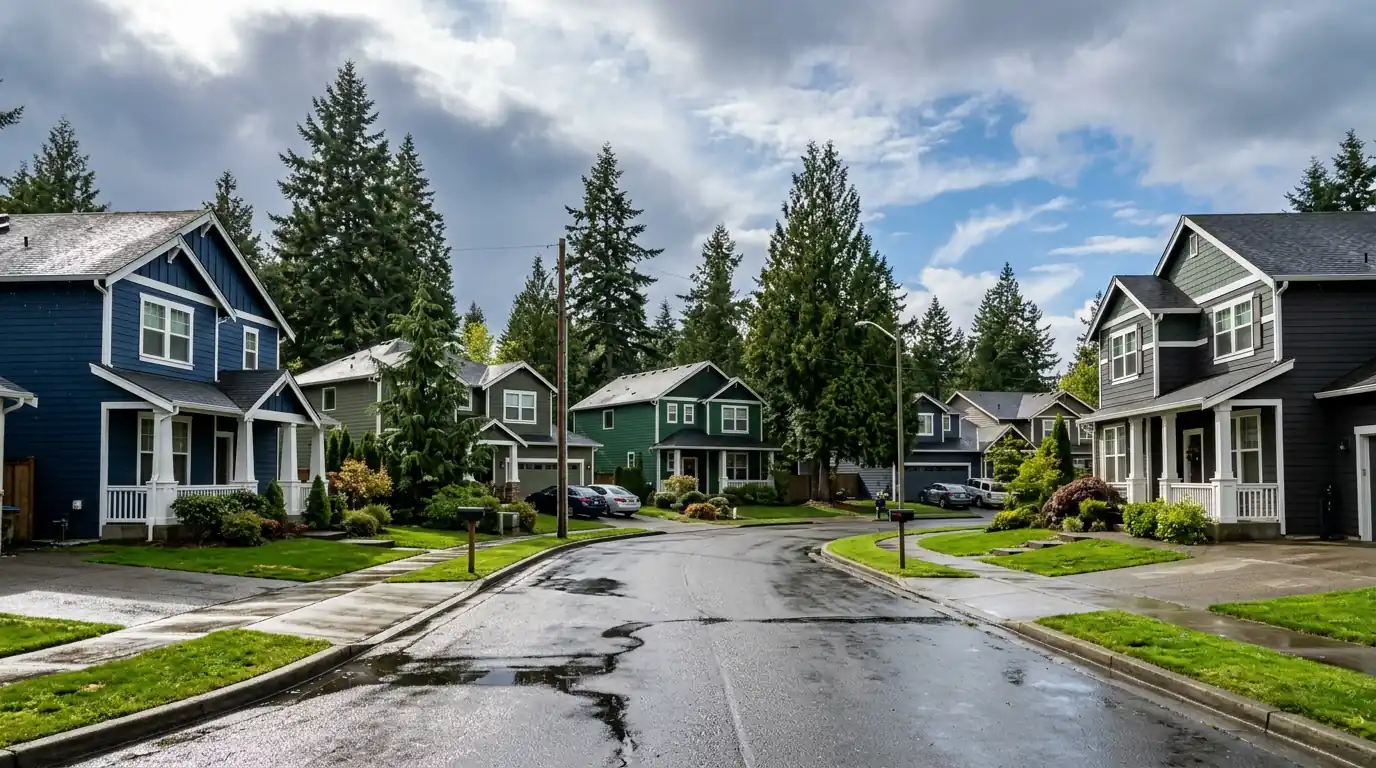
Dew, cold nights and short fall days
Rain is the obvious risk, but dew causes plenty of trouble on its own. On clear nights the siding cools fast and collects moisture, and in our area that dew can sit on shaded walls until late morning. Paint applied too early on those surfaces may stay tacky, lose sheen or show streaks. Fresh paint that gets hit by heavy dew in the evening can do the same. We start on sunny sides first, move to shaded walls once they dry, and stop early enough in the afternoon for the last coat to set.
In September the days get shorter and nights cool off, which cuts the hours when paint can go on and cure properly. Many exterior paints list a minimum application temperature, often somewhere around 35 to 50 degrees depending on the product, and the surface also needs to stay above the dew point while it cures. We follow the label for each product. Late season jobs are still possible on good weeks, but they move more slowly, and we will tell you plainly if waiting for next spring is the better call.
- Start on sun-facing walls, then shaded walls once dew burns off
- Stop each coat early enough to set before evening dew
- Check the label for the minimum surface temperature
- Keep surfaces above the dew point while paint cures
- Plan coats around forecast dry gaps, not just the first day
What to do in the off season
The wet months are not wasted time. Interior work runs all year, and fall and winter often have the most open dates for interior painting, cabinets and trim. If your exterior needs both repairs and paint, some of the repair work can happen during drier spells in early spring. Replacing rotted fascia or window sills, then priming the new wood right away, means the full exterior repaint can start as soon as the weather turns. The off season is also a good time to settle on colors and test samples on the house.
Washing is another piece that can come first. Moss and mildew build up on north walls, roof edges and decks through the winter, and pressure washing or soft washing in late spring clears that growth before prep begins. The siding then needs time to dry back down before primer, often a couple of dry days in summer and longer in spring. Splitting the project this way keeps the main painting days focused on painting, which makes the most of the dry window when it finally arrives.
How we plan around the weather on your job
When we schedule an exterior, we look at the forecast for the full week, not just the first day. Each side of the house is painted when it tests dry, and we keep coats on a schedule that gives paint time to set before rain or dew arrives. If showers move in, we cover what is needed, pause, and pick up again when the surface is ready. You will hear from us whenever the plan changes, so you are never left guessing whether a crew is coming that morning.
Salt air adds one more factor for homes along Ruston Way, Browns Point and other shoreline spots on Commencement Bay and Puget Sound. Salt residue left on siding can weaken adhesion, so those homes get a careful fresh-water rinse before prep. Waterfront homes also see stronger wind, which affects spray work and drying. None of this stops a good job, it just shapes the schedule. To get on the summer calendar, call (253) 478-2745. We answer 24/7, and we're happy to talk through timing first.
Geneva Bixby, Paint Tips Editor at Cole's Pro Painting. Geneva writes our homeowner guides from what our crews see on Tacoma and Pierce County jobs.